
10/04/2026
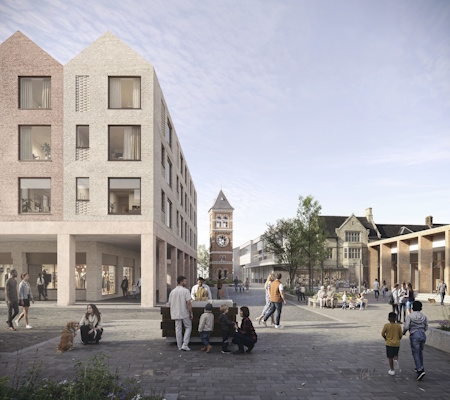
A new blueprint which could see food court, smaller retail outlets, an expansion to the town’s college, and improved public spaces at the heart of Stafford, has been agreed.
Senior borough councillors heard that work to demolish and prepare the groundwork for development in the town centre had created ‘significant developer interest.’
Deputy leader, Councillor Rob Kenney, said it was a framework for an attractive, modern and well connected town centre with a focus on heritage that would provide a “strong county town identity” – and would “bring in high quality developers.”
A report to the council’s Cabinet stated that, with people’s shopping habits and leisure requirements changing, old-fashioned town centres across the country were no longer fit for purpose and needed to evolve.
The council has now drawn up a framework of how Stafford will thrive with town centre living, improved public spaces, market hall - including food court, entertainment, competitive socialising, and artisan traders - and office space.
The full cabinet report and framework document can be seen from the council’s website.
Councillor Ian Fordham, Cabinet Member for Environment, told the meeting on Thursday (9 April) the framework was “Truly exciting” and would “create a positive, lasting legacy for this council, and to the significant benefit of our existing and future residents.”
Described as the biggest transformation in the county town in a generation – the vision was kick-started when Stafford Borough Council used government money to buy the ailing Guildhall Shopping Centre and derelict former Co-op department store - which have both now been razed to the ground.
The iconic frontages of both the Guildhall and Co-op will be retained as part of the development and other historic landmarks are to be incorporated in the plans.
Council leader, Aidan Godfrey, said: “Our ‘Development Framework’ is an important part of the next stage of work within the regeneration programme. It sets out the Council’s expectations and will shape future development proposals.
“It means a shift away from tired and vacant shopfronts in a high street that operates primarily in the daytime to a place that people are proud to live in and, equally importantly, want to spend their time in.”
It could see up to 200 new homes, over 3,000 square metres of commercial space including a new Market Hall, 6,000 square metres of education space to support the expansion of Stafford College, and just under 3,000 square metres of improved public spaces.
A planning application to demolish the former Wilko site which also forms part of the regeneration plans has been submitted.
The report stated that they were ‘now entering a critical and exciting phase in the delivery of the Stafford Town Centre Transformation process. It is intended that the Council moves forward at pace, to secure development partner(s) that share the Council’s vision and this will act as a catalyst for the wider regeneration of the town centre creating confidence in Stafford as the county town as a place to live, work, invest and visit.’
Councillor Kenney added: “The fact that the Council took the lead in the acquisition, demolition and site clearance works has built confidence in the regeneration programme with investors and we must ensure that this momentum is not lost.”
As well as being used to purchase key buildings, money from the Future High Streets Fund has already paid for refurbishment of the Market Square and enhanced the approach and entrance to Stafford Railway Station.
There has also been major investment in the county town over recent years with the £22m Institute of Technology campus opening last year, the £9m Staffordshire History Centre, and preliminary work starting soon on the Stafford Station Gateway project - which is backed by £20m of government funds.
The Development Framework will now be shared with potential investors at the UK Real Estate, Investment and Infrastructure Forum in May.
Press Release No 6285